
WHALE WATCHING IN OCEANSIDE IN JULY: A LOCAL’S GUIDE TO PEAK BLUE WHALE SEASON
If you only get one shot at whale watching in Southern California this summer, July is the month. We say that as people who run these catamarans out of Oceanside Harbor every single day, in every season, year-round. By the first week of July, blue whales — the largest animal that has ever lived on Earth — are showing up in numbers along the coast we run, and they stay close into August.
This is a local’s guide to what July whale watching out of Oceanside actually looks like. What species are showing, what the water is doing, what time of day works best, and what to wear when the sun is high and the wind is up. Written by the crew who has been on these boats for the last decade.
Why July Is Peak Blue Whale Season
Blue whales follow krill. Specifically, they follow swarms of cold-water krill (mostly Thysanoessa spinifera and Euphausia pacifica) that bloom along the California Current in summer. From late spring through early fall, upwelling along the coast pushes nutrient-rich cold water to the surface, the krill explode, and the blue whales follow them right into the Southern California Bight.
That feeding window peaks in July. By mid-month, the Southern California coastline north of San Diego sits inside one of the most reliable blue whale feeding zones on the planet. Oceanside Harbor sits in the heart of that zone, with the deepwater banks where the blue whales feed only a short run from the breakwater.
The science backs up what our captains see from the wheel. Long-running NOAA studies on California Current blue whale ecology document a peak in surface lunge-feeding activity between mid-June and mid-August. Those are exactly the weeks we are running.
The Oceanside Geographic Edge
Oceanside is unusual among Southern California whale watching ports because the deepwater whale zones start so close to the harbor. The Oceanside Canyon, a submarine canyon that drops sharply offshore, brings cold, nutrient-rich water close to the coast and gives our catamarans a short run to where the whales actually feed. We have written about how the Oceanside Canyon delivers the action before, and the July blue whale season is the clearest illustration of why that geography matters.
For visitors staying anywhere in North County San Diego — Carlsbad, Vista, Camp Pendleton, Encinitas, Escondido — Oceanside is the closest deepwater whale watching launch point. It is also closer to the action than longer harbor runs further south.
What You Will Actually See on a July Trip
July is busy out there. On a typical two-hour trip aboard NALA, we are looking at:
- Blue whales. The headliners. We routinely see one to three blue whales on a single trip during peak weeks. They lunge-feed at the surface, then dive for 8 to 15 minutes, then come back up. Patient boats get rewarded.
- Fin whales. The second largest animal on Earth. Fast, sleek, often traveling in pairs. We have had outstanding fin whale sightings throughout the spring and they continue into summer.
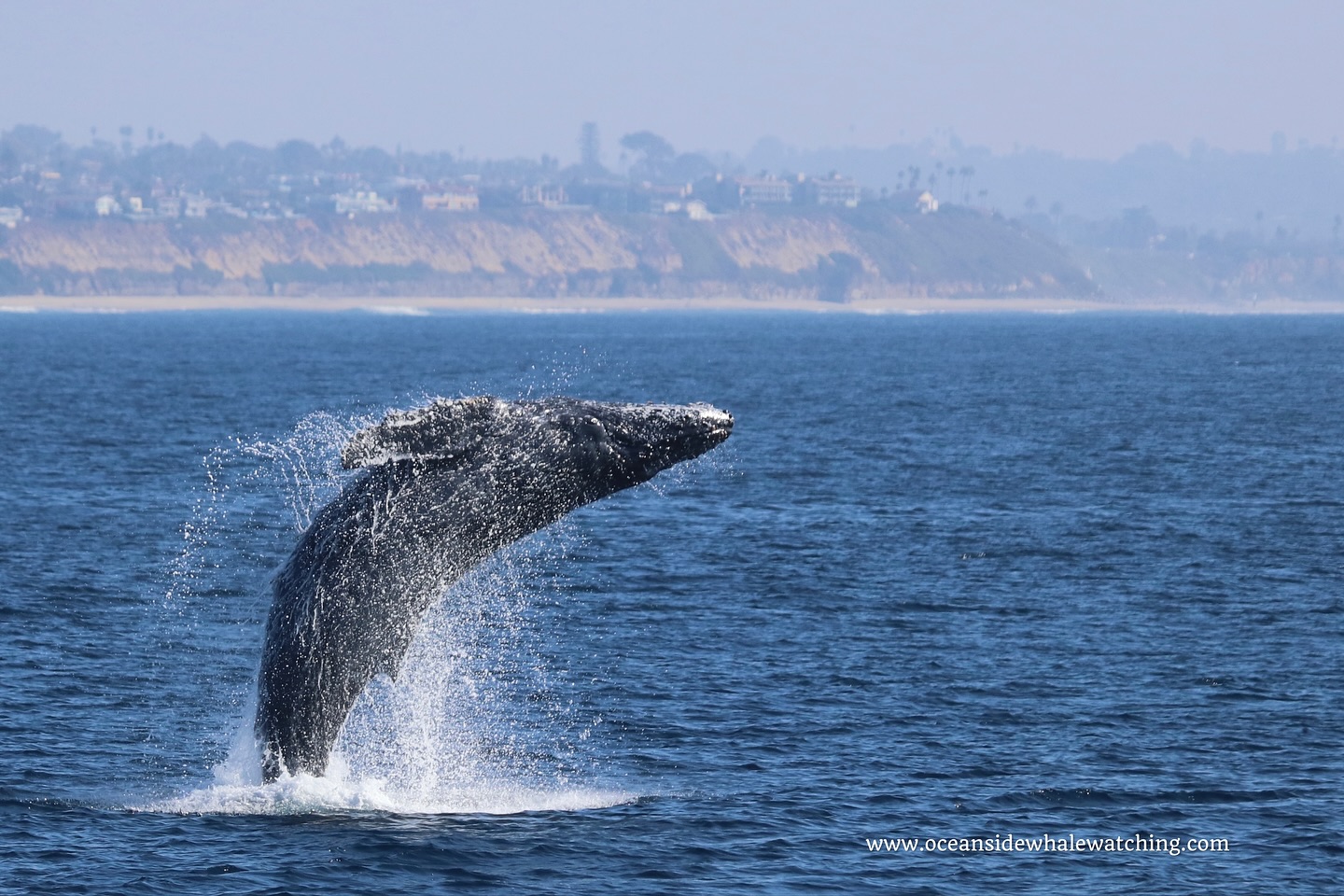
- Humpback whales. Smaller than blues and fins but the most acrobatic, with regular breaches and fluke-up dives. Our humpbacks have been on a tear all spring.
- Minke whales. Smaller, faster, harder to spot. When one breaches on a July trip it’s a moment.
- Common dolphins. By the hundreds. Sometimes by the thousands. A megapod day in July is one of the best things you can witness on the water.
- Bottlenose dolphins. Bigger and more inshore, working the kelp line within a mile of the harbor mouth.
- Mola mola (ocean sunfish). Big, prehistoric-looking, sunbathing on the surface. Summer is the season for them.
- Sea lions and the occasional sea turtle.
For the supporting cast, our guide to Oceanside’s marine wildlife covers the full picture.
What the Water Looks Like in July
The Pacific off Oceanside in July is, by California standards, warm and friendly. Surface temperatures run 65 to 70 degrees most of the month. The morning marine layer typically burns off by mid-morning, leaving glassy mornings followed by an afternoon westerly that puts a small chop on the water by 2 p.m. The catamaran handles all of it smoothly thanks to the twin-hull design, which is one of the reasons we run the boat we run. We wrote about that specifically in why a catamaran is your best friend on the water.
Swell is small in July, typically a couple feet of long-period south swell from the Southern Hemisphere mixed with a small northwest windswell. Translation: it is the smoothest ride of the year. If you are worried about seasickness, July is the easiest month to take your first trip. Our seasickness guide covers the small habits that make a big difference.
Best Time of Day in July
Our honest answer: morning trips are the sweet spot. The water is glassier before noon, the light is better for spotting blows from a mile off, and the blue whales tend to feed actively on the morning krill push.
That said, July afternoon trips have an underrated edge. The sun is high and the visibility into the water is excellent, which means when a whale dives below the surface you can sometimes follow the shape of it underwater for a few seconds longer. And the evening trips in midsummer have their own magic — golden hour light and a cooler deck. We wrote about that specifically in our evening tour piece.
What to Wear and Bring
The combination of moving boat, sea breeze, and ocean evaporation drops the felt temperature 15 to 20 degrees below what the inland thermometer suggests. Even in July.
The minimum kit:
- Lightweight long-sleeve layer over a t-shirt
- A thin windbreaker or shell
- Polarized sunglasses (huge for spotting whales underwater)
- A hat with a chin strap (or a hood you can use instead)
- Closed-toe shoes with grip — flip flops are not your friend on a moving deck
- Reef-safe sunscreen, applied before boarding and reapplied once
- A camera or phone with a wrist strap
- Cash for the crew tip jar
For the full pre-trip packing list, our summer packing guide covers everything. Our what-to-wear guide has the year-round version.
Booking and Practical Notes
July is our busiest whale watching month of the year. Weekend trips book out a week or more in advance. If you can do a Tuesday, Wednesday, or Thursday trip, you get a less crowded boat, a better position at the rail, and the same shot at the same whales.
Trips run from the dock at 256 Harbor Drive South, right in front of the historic lighthouse. Parking is straightforward, the walk to the boat is short, and the harbor itself is small and walkable. Give yourself 30 to 45 minutes before boarding to park, check in, and grab a coffee from the harbor cafe.
For the deeper July experience, we run private charters as well. Same boat, same waters, your group only. Our private charter piece walks through what those look like.
Why Oceanside Is the Right July Choice for North County
For visitors staying anywhere in North County San Diego, Oceanside Harbor is the closest deepwater whale watching launch point and one of the best in California for July blue whale sightings. The combination of the Oceanside Canyon’s geography, the timing of the krill bloom, and our captains’ decades of experience reading these waters means a higher chance of multiple species per trip than almost anywhere else along the SoCal coast.
If you are coming down from Orange County or further north, our sister operation Dana Wharf in Dana Point is also running peak summer trips out of Dana Point Harbor with the same family ownership behind it.
Plan Your July Whale Watching Trip
To book, head to our whale watching page for the live July schedule, or check our recent trip recaps to see what we have been logging this week. If you have questions our crew can answer on the phone every day, or our FAQ covers the rest.
See you on the water.