
FIN WHALES IN OCEANSIDE: MEET THE SECOND-LARGEST ANIMAL ON EARTH
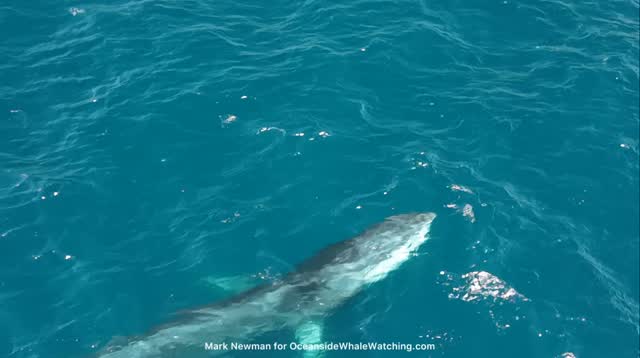
Some mornings off Oceanside the ocean looks almost flat, and then a column of mist shoots fifteen or twenty feet into the air, hangs there for a second, and drifts off on the breeze. By the time most of our guests register what they are looking at, a long charcoal-gray back is already sliding back under the surface. That is a fin whale, and this spring and summer they have been one of the most thrilling sights off our coast.
Fin whales do not breach and slap their tails the way humpbacks do, so they have a quieter reputation. But once you know what you are looking at, they are arguably the most impressive animal you can see from Oceanside Harbor. They are the second-largest creature ever to live on Earth, they move faster than almost anything else in the ocean, and right now they are cruising the deep water just off our coast. Here is everything you need to know before you join us on the water.
What Is a Fin Whale?
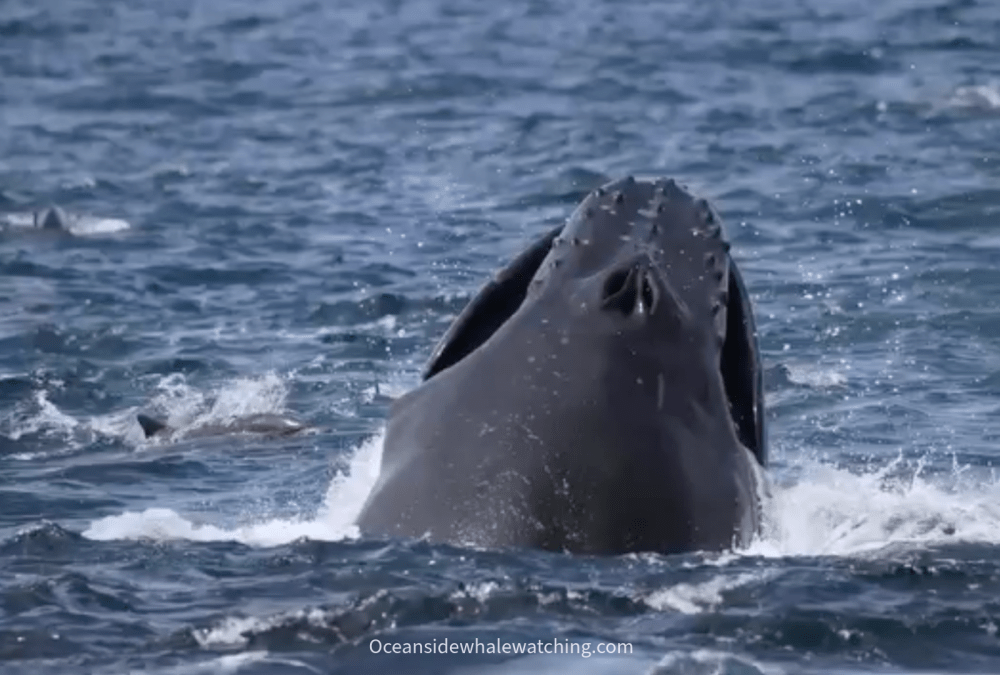
The fin whale (sometimes called the finback) is the second-largest animal on the planet, surpassed only by the blue whale. Adults reach roughly 75 to 85 feet long and can weigh somewhere between 40 and 80 tons. To put that in perspective, a large fin whale is longer than the catamaran many of our guests ride on, and it is swimming free in the water right next to you.
What makes them truly remarkable is not just their size but their speed. Fin whales are built like torpedoes, with a sleek, streamlined body and a sharply pointed head, and they have earned the nickname “the greyhound of the sea.” They can cruise comfortably around 23 to 25 miles per hour and hit short bursts close to 29 miles per hour. For an animal the length of a basketball court, that is genuinely astonishing, and it is part of why a fin whale sighting can be so quick. They surface, blow a few times, and are gone, covering ground faster than almost any other large whale.
How Do You Tell a Fin Whale from a Blue Whale?
This is the question our naturalists field most often once fin whales show up, because the two species share the same deep water off Oceanside in the warmer months and can look similar from a distance. A few details give it away every time.
Color is the first clue. Blue whales have a mottled blue-gray look that can appear almost light blue in bright sun, while fin whales are a darker, more uniform charcoal gray with a paler underside. The dorsal fin is the next tell. A fin whale carries a noticeably taller, more curved (“falcate”) fin set about two-thirds of the way down its back, and you often see that fin clearly as the animal arches to dive. Blue whales have a much smaller, stubbier fin that can be hard to spot at all. Finally, watch the dive. A blue whale frequently lifts its tail flukes before a deep dive; fin whales rarely show their flukes, so a big whale that slips under without raising its tail is very often a fin. If you want to dig deeper into the other giant sharing our water, our guide to spotting blue whales in Oceanside covers that species in detail.
What Makes a Fin Whale So Easy to Recognize?
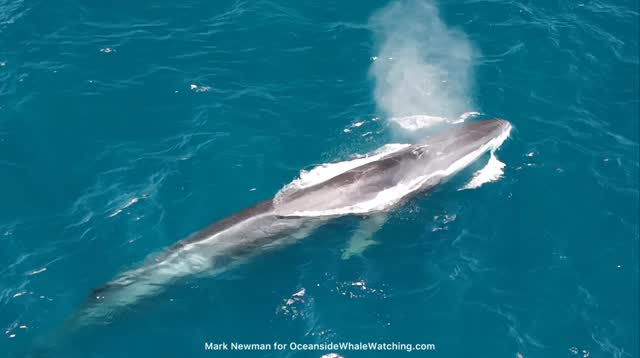
Beyond size and speed, fin whales carry one of the strangest features in the animal kingdom: their jaw is two different colors. The lower right jaw is bright white, while the lower left jaw is dark gray. No other whale has this kind of asymmetrical coloring, and scientists still debate exactly why it exists. The leading idea ties it to the way fin whales feed. They often roll onto their right side when they lunge into a school of fish or krill, and the pale right jaw may help herd or startle prey into a tighter ball, making each gulp more efficient. Whatever the reason, it is so distinctive that researchers use the pattern to identify individual whales.
The other giveaway is the blow. A fin whale’s exhale is tall and narrow, shooting up to about 20 feet in a tight column that you can often see well before you make out the body. When the water is calm, which it frequently is in our protected stretch of coast, that towering spout is usually the first thing our captains call out. Pair the tall blow with a dark back and a prominent dorsal fin, and you have a confident fin whale identification.
When Can You See Fin Whales in Oceanside?
Fin whales are around our coast much of the year, but the sightings really pick up from spring into summer, and that is exactly the window we are in now. Through late spring and into the summer months, the deep water off Oceanside fills with the small fish and krill that fin whales, blue whales, and other large rorquals come to feed on. That food is the whole reason they are here, and it is why summer is such a productive season for big-whale sightings.
If you are planning a trip and want to understand the full year of whale activity off our coast, our complete seasonal guide to whale watching in Oceanside breaks down what to expect month by month. Summer in particular is a standout stretch, and our look at why July is peak blue whale season explains why the same warm-water conditions that bring blue whales also bring fin whales right alongside them.
For an even deeper dive into fin whale biology, behavior, and feeding, our sister company put together a thorough complete guide to fin whales that is well worth a read before your trip.
Why Oceanside Is a Front-Row Seat for Fin Whales
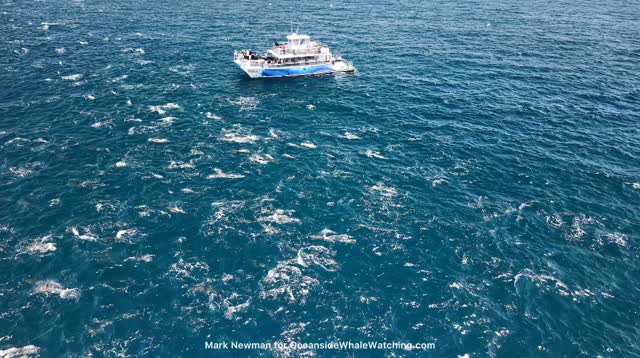
Fin whales like deep water, and one of Oceanside’s quiet advantages is how quickly the seafloor drops away just outside the harbor. A short run from the dock puts you over the kind of deep, food-rich water these whales prefer, which means more time watching whales and less time getting to them. Our harbor is also uncrowded and easy to reach from across North County, so the whole experience feels calmer and more personal than the bigger, busier ports.
Every tour is narrated by a certified naturalist who can call out the difference between a fin whale and a blue whale in real time, point out that tall spout before you would have spotted it, and explain what the animal is doing and why. Whether you are aboard our 50-foot catamaran or NALA, our 63-foot double-deck catamaran, you get a stable, comfortable platform with great sightlines. You can read more about both vessels on our boats page.
What Else Might You See Out There?
Fin whales may be the headliners this time of year, but they rarely have the ocean to themselves. On the same trip you might cross paths with blue whales, humpbacks putting on a more acrobatic show, minke whales, and the big, fast-moving dolphin pods our coast is famous for. If you want a sense of the full cast of characters, our post on the humpback whales of Oceanside and our roundup of everything else you can see on a tour are great places to start. No two trips are ever quite the same, which is exactly what keeps our crew excited to head out each morning.
Ready to See a Fin Whale for Yourself?
There is nothing quite like watching the second-largest animal on Earth glide past your boat, close enough to hear that explosive breath. Fin whales are off our coast right now, the water has been beautiful, and the season is only getting better. Come find out why a quiet harbor and a quick run to deep water make Oceanside one of the best places in Southern California to meet these giants.
Browse departure times and reserve your spot on our whale watching cruise page, or check the live booking calendar and pick the day that works for you. We will see you at the harbor.