
HUMPBACK WHALES IN OCEANSIDE: WHY THIS IS A YEAR-ROUND DESTINATION
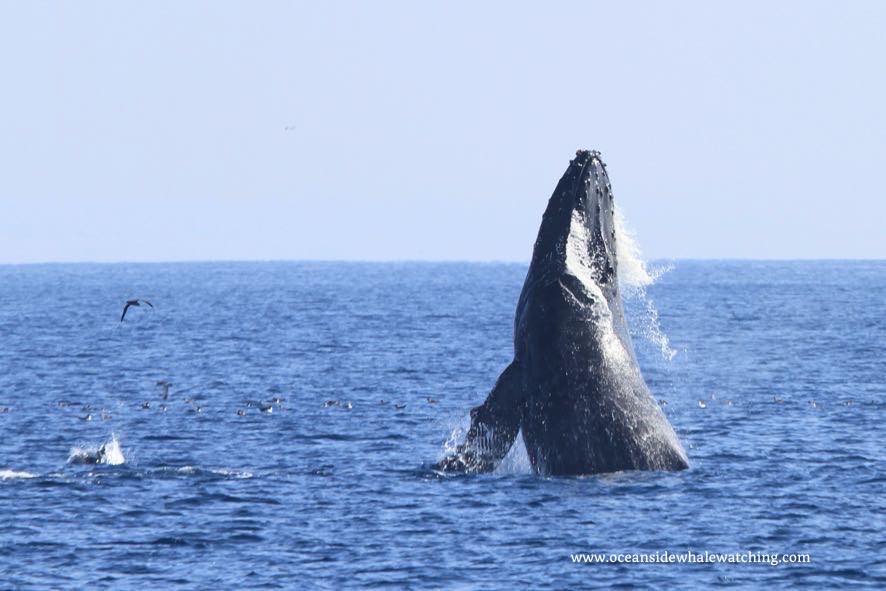
Most people think of humpback whales and picture Alaska or Hawaii. What they don’t realize is that humpback whales are spotted off Oceanside, California throughout the entire year, and the sightings have been getting better.
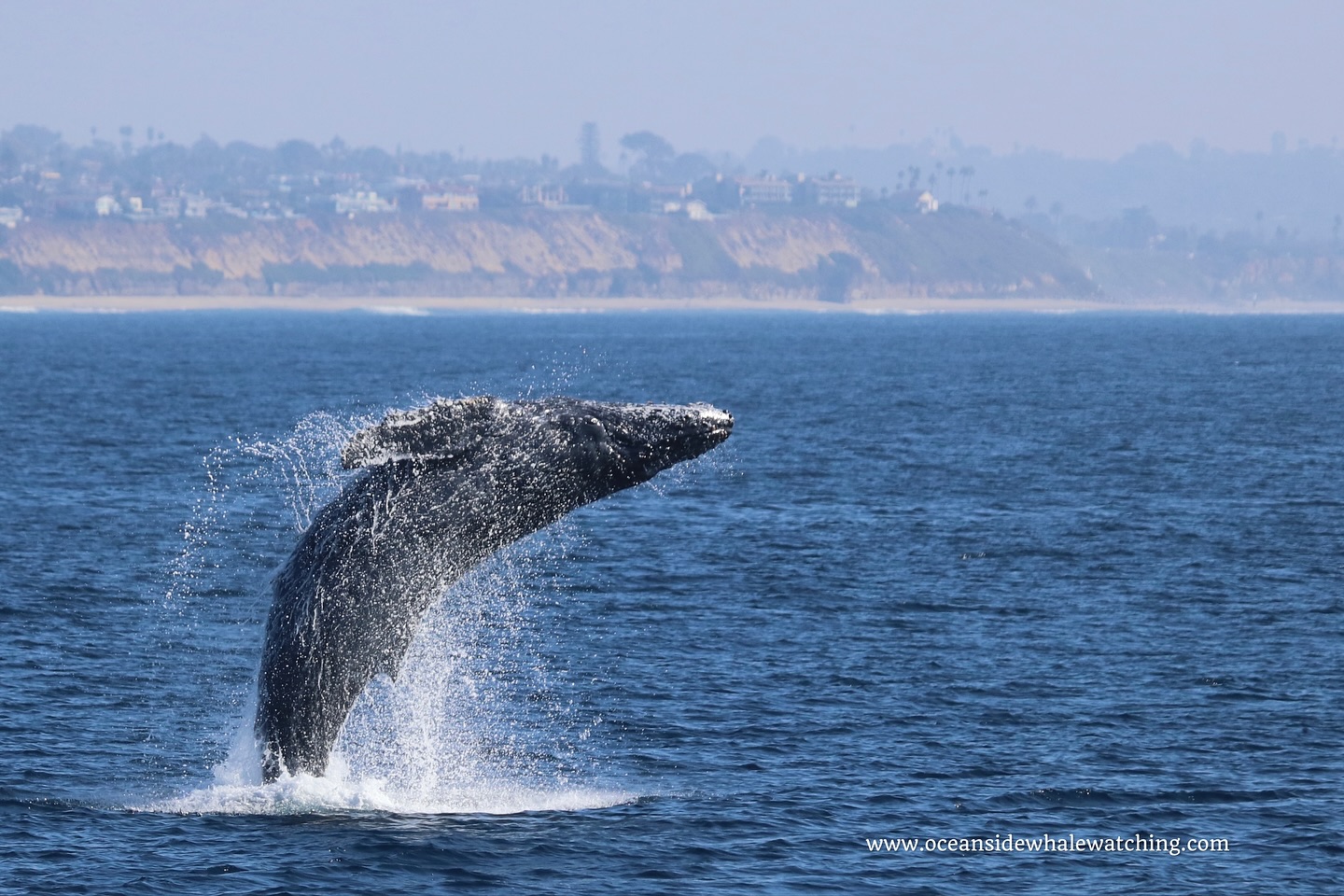
Our captains have watched this shift firsthand. A decade ago, humpbacks in Southern California were mostly a summer thing. Now we’re seeing them in November, February, April, and everywhere in between. On some trips, humpbacks are the main event. They breach within view of the boat, slap their tails on the surface, and roll on their sides with one massive pectoral fin pointing straight at the sky. It’s the kind of encounter that makes people forget they were ever nervous about seasickness.
If you’re looking for humpback whale watching near San Diego, Oceanside Harbor might be the best departure point you haven’t considered yet.
What Makes Humpback Whales So Easy to Spot
Humpback whales are, by whale standards, show-offs.
They’re big. Adults reach 45 to 60 feet in length and weigh around 25 to 40 tons. Their pectoral fins alone can stretch 15 feet, making them the longest appendage of any animal on Earth. When a humpback surfaces to breathe, the blow is visible from a long distance: a tall, bushy spout that our captains can spot from over a mile away.
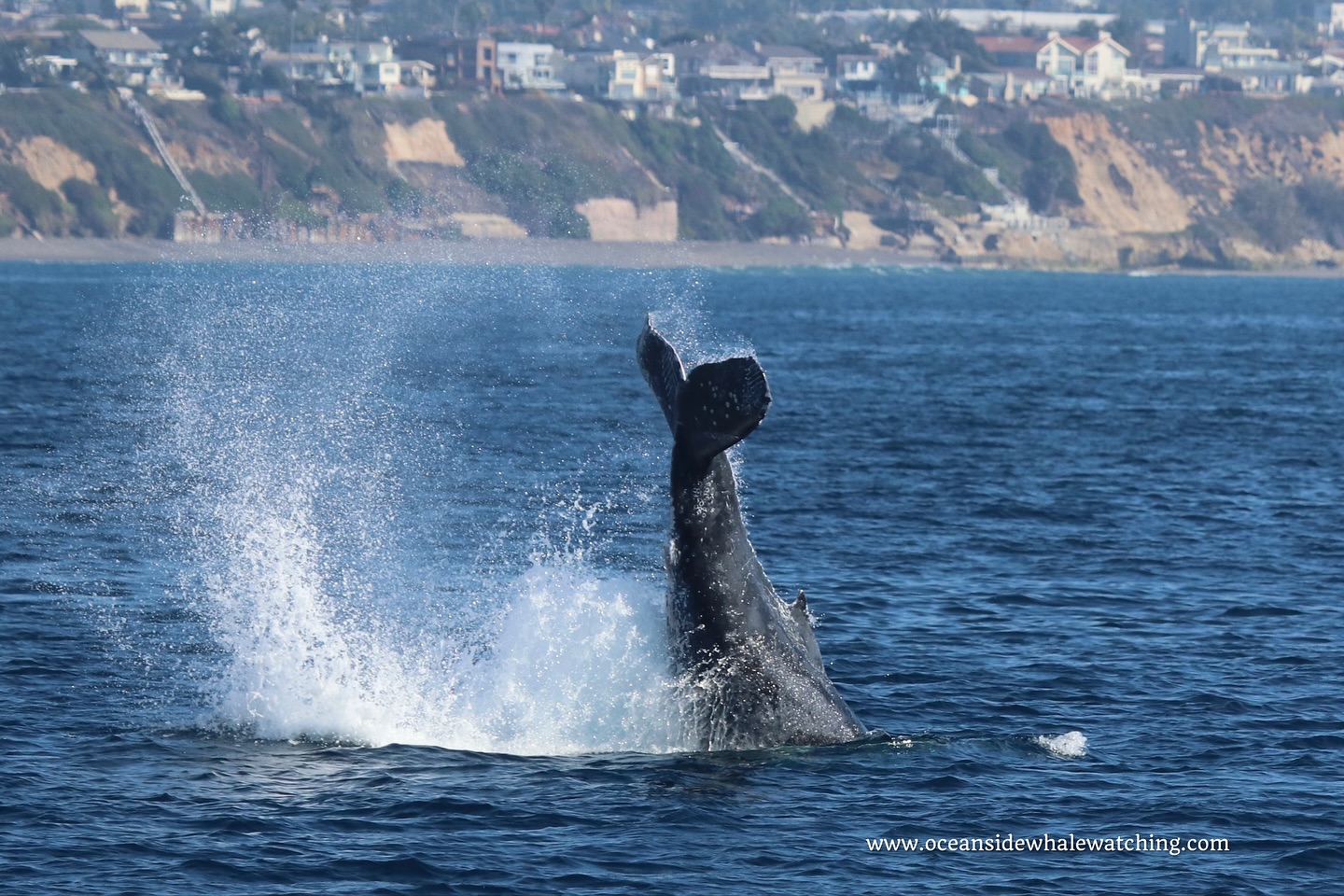
But what really sets humpbacks apart is their behavior. They breach (launch their full body out of the water), tail-slap, pec-slap, and spy-hop more than almost any other whale species. Scientists still debate exactly why they do it. It may be communication, parasite removal, or just play. Whatever the reason, it makes for an unforgettable experience on a whale watching cruise.
Humpbacks are also identifiable as individuals. The underside of every humpback’s tail fluke has a unique black-and-white pattern, like a fingerprint. Researchers use these patterns to track individual whales across years and thousands of miles. On your tour, our naturalist may be able to tell you if a whale has been seen in our waters before.
When Can You See Humpback Whales in Oceanside?
The honest answer: any month of the year. But the timing and frequency shifts with the seasons.
Summer and early fall (June through October) is historically the peak feeding season for humpbacks in Southern California. They come north from their breeding grounds in Mexico and Central America to feed on krill and small schooling fish like anchovies and sardines. The nutrient-rich waters of the Southern California Bight, fueled by cold upwelling currents, create exactly the kind of dense prey patches that humpbacks target.
Late fall and winter (November through February) used to be considered the off-season for humpbacks in our area, with gray whales taking the spotlight during their southbound migration. That’s changed. In recent years, humpback sightings off Oceanside during November and December have been some of the best of the year. Some humpbacks appear to be delaying their southbound migration or skipping it entirely, feeding in Southern California waters well into winter.
Spring (March through May) brings northbound humpbacks returning from breeding grounds in the warm waters of Mexico and Central America. Some stop to feed along the way, and Oceanside’s coastal waters are right in the path.
The key takeaway: there is no single “humpback whale season” in Oceanside anymore. Our daily tours encounter humpbacks throughout the calendar. The best times for whale watching page has the full seasonal breakdown for all species.
Why Humpbacks Are Staying Longer in Southern California
This is one of the more interesting things our captains have observed over the past several years, and the science backs it up.
Historically, humpback whales in the North Pacific followed a predictable pattern: feed in cold northern waters during summer, migrate south to warm tropical waters to breed during winter, then repeat. The California coast was a waypoint, not a destination.
That pattern is shifting. Researchers at Cascadia Research Collective and other organizations have documented humpbacks spending more time in Southern California, including areas they weren’t regularly seen in 20 years ago. The estimated North Pacific humpback population grew at roughly 3% per year from 2002 through 2021, reaching an estimated 26,600 animals. More whales means more competition for food in traditional feeding areas like Alaska, which may be pushing some individuals farther south and keeping them there longer.
Changes in ocean temperature and prey distribution also play a role. When anchovy and sardine populations are strong off Southern California (as they have been in recent years), humpbacks have less reason to continue north. Why travel an extra 2,000 miles when dinner is right here?
For whale watchers in Oceanside, this is great news. It means more humpback encounters, more months of the year, and a better chance of seeing their signature behaviors.
How to Identify a Humpback Whale from the Boat
When our certified naturalist spots a humpback, here’s what to look for:
The blow. Humpback whale blows are tall and bushy, reaching 10 to 15 feet high. They’re visible at a distance before you can see the whale’s body.
The dorsal fin. Humpbacks have a small, stubby dorsal fin about two-thirds of the way back on their body, often sitting on a slight hump (which is where the name comes from). It’s much smaller relative to body size than a fin whale’s or a blue whale’s dorsal.
The fluke. When a humpback prepares for a deep dive, it raises its tail high out of the water, giving you a clear view of the underside with its unique black-and-white pattern. Not all whales “fluke up” on every dive, but when they do, it’s a perfect photo opportunity.
The pectoral fins. These are unmistakable. At up to 15 feet long and bright white on the underside, humpback pectoral fins are the longest of any whale. You’ll sometimes see a whale lying on its side at the surface with one fin sticking straight up like a sail.
Breaching. A humpback breach is one of the most dramatic things you’ll see in nature. The whale powers upward from below the surface and launches most or all of its 30-to-40-ton body into the air, then crashes back with a splash visible from half a mile away. If you see one breach, keep watching. Humpbacks often breach multiple times in a row.
Humpback Whales vs. Other Species Off Oceanside
Oceanside waters are home to several whale species, and it helps to know the differences.
Gray whales are the primary species during winter migration (November through April). They’re coastal navigators, traveling close to shore. Gray whales are mottled gray with barnacles and don’t breach as frequently as humpbacks.
Blue whales are the giants, seen primarily from late spring through fall. They’re longer (up to 100 feet) but thinner than humpbacks, and their behavior is more subdued: long, slow surfacing patterns with a tiny dorsal fin set far back on the body. You can read more in the dedicated blue whale guide.
Fin whales are the second-largest animal on Earth and are seen year-round off Oceanside. They’re fast swimmers with an asymmetrical jaw coloring (white on the right, dark on the left) that makes them uniquely identifiable.
Humpbacks are more compact and muscular than the other large whales, with those long pectoral fins, a knobbly head studded with tubercles (hair follicle bumps), and far more surface activity. If a whale is breaching, tail-slapping, or rolling at the surface, it’s almost certainly a humpback.
What You Can Expect on a Humpback Whale Tour
Oceanside Adventures operates two vessels for whale watching: a 50-foot catamaran and NALA, a 63-foot double-deck catamaran with a raised platform for optimal 360-degree viewing. Both were built by Cooper Marine and feature custom Wyland-designed wraps depicting marine life. NALA’s wrap features a blue whale mother and calf.
Tours depart from Oceanside Harbor, right in front of the historic Lighthouse. Free parking is available at the harbor. The boat reaches deep, productive water within minutes of departure because the continental shelf drops off close to shore here. That means less transit time and more time with the animals.
Every tour is narrated by an expert captain and certified naturalist who can identify individual whales, explain what behaviors you’re seeing, and answer questions in real time. If a humpback is breaching in the distance, the captain will adjust course to give you the best viewing angle while maintaining the legally required 100-yard distance under the Marine Mammal Protection Act (though humpbacks sometimes close that gap on their own).
Tours are two hours long, depart daily, and are suitable for all ages. Check the calendar and book online to reserve your spot.