
TYPES OF DOLPHINS YOU CAN SEE IN OCEANSIDE, CALIFORNIA
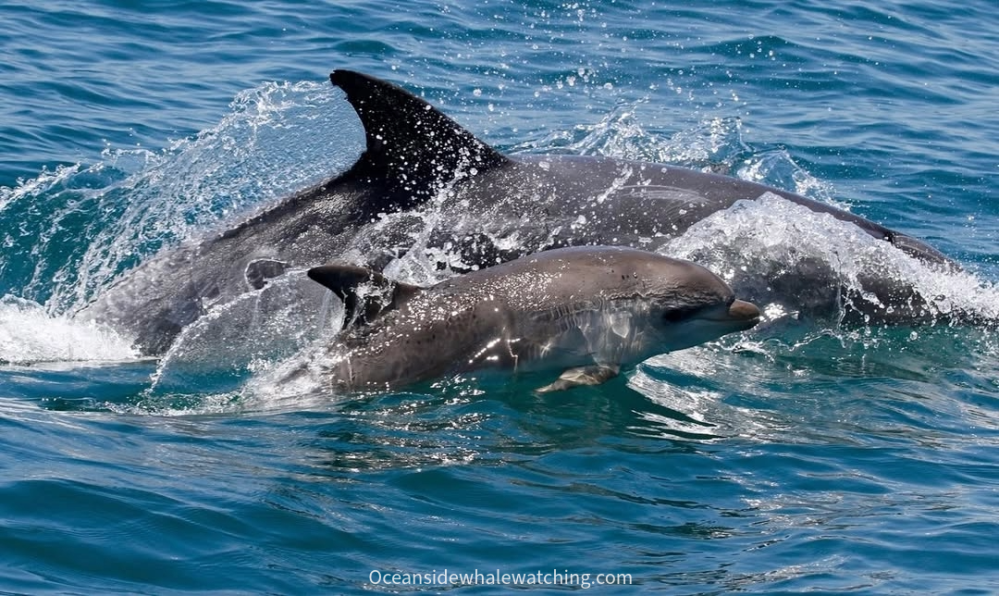
People book a whale watching trip hoping to see a whale. What they don’t always expect is that the dolphins will steal the show.
On most Oceanside Adventures tours, we encounter dolphins within minutes of leaving the harbor. The continental shelf drops off fast here, and that quick transition from shallow to deep water creates a feeding corridor that dolphins use year-round. We’re talking pods of hundreds, sometimes thousands, racing alongside the boat, riding the bow wave, launching into the air. Guests come back talking about the dolphins as much as the whales.
Oceanside sits along one of the richest stretches of the Southern California Bight, and our waters are home to four distinct dolphin species. Each one looks different, behaves differently, and shows up in different conditions. Here’s what our captains and naturalists see out there every week.
Common Dolphins: The Ones That Travel in the Thousands
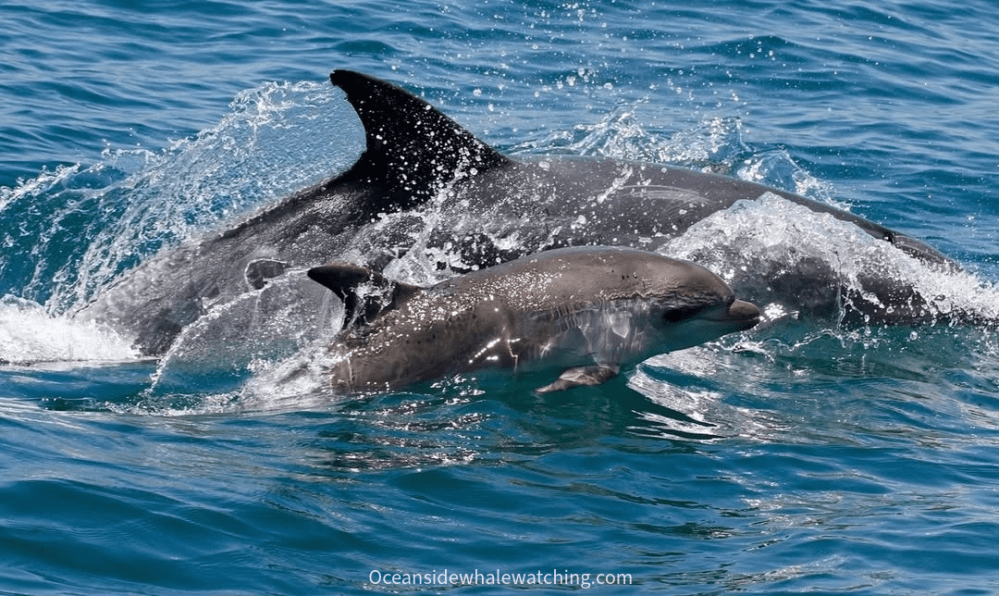
If you’ve seen footage of massive dolphin pods stretching to the horizon, you were probably looking at common dolphins. These are by far the most abundant species off Oceanside, and encountering a large pod is one of the most spectacular things you’ll ever see on the water.
Common dolphins are easy to identify. They have a distinctive hourglass pattern on their sides, with a yellowish-tan patch near the head that blends into gray toward the tail. They’re smaller than bottlenose dolphins, typically 6 to 8 feet long and around 150 to 250 pounds.
What makes them unforgettable is the sheer number. Common dolphin pods off Oceanside regularly number in the hundreds, and superpods of 1,000 or more are not unusual. They’re fast, acrobatic, and absolutely love to bow-ride. When a pod decides to travel with the boat, you’ll see dolphins leaping, spinning, and crisscrossing under the hull from every angle.
There are actually two types of common dolphins in our waters: short-beaked and long-beaked. The short-beaked variety tends to stay farther offshore in deeper water, while the long-beaked common dolphin sticks closer to the coast and the continental shelf. On a typical Oceanside Adventures tour, you may encounter both, sometimes in the same pod.
Common dolphins are present year-round off Oceanside. They don’t migrate. That consistency is a big part of why our success rate for dolphin sightings is so high regardless of the season.
Bottlenose Dolphins: The Coastal Residents
Bottlenose dolphins are the ones most people picture when they hear the word “dolphin.” They’re the species made famous by TV and marine parks, and they’re a regular presence in the waters right around Oceanside Harbor.
They’re larger and more robust than common dolphins, typically 8 to 12 feet long and 400 to over 1,000 pounds. Their coloring is a uniform gray, darker on top and lighter underneath, without the hourglass pattern. The rounded forehead (called a melon) and the short, thick snout give them that classic dolphin profile.
What sets bottlenose dolphins apart behaviorally is how close to shore they live. The coastal population of bottlenose dolphins in Southern California stays within about a half mile of the beach, patrolling the surf zone and harbor entrances for fish. You can sometimes spot them from the Oceanside Pier or the harbor jetty. On the boat, we often see them as we’re heading out or coming back in, working the shallows right along the breakwall.
Bottlenose dolphins travel in smaller groups than common dolphins, usually pods of 2 to 15 individuals. They’re curious and will often approach the boat on their own terms. Research from the Ocean Conservation Society has documented over 400 individual coastal bottlenose dolphins in Southern California waters, and photo-identification studies have tracked some individuals traveling the entire coast from San Diego to San Francisco.
These are year-round residents. No migration, no off-season. If you’re on the water off Oceanside any day of the year, there’s a strong chance bottlenose dolphins are nearby.
Risso’s Dolphins: The Scarred Deep-Water Hunters
Risso’s dolphins are the most visually distinctive species you’ll encounter off Oceanside, and honestly, they’re a lot of people’s favorite once they see one up close.
They’re big, growing up to 13 feet and over 1,000 pounds. But the most striking feature is their skin. Risso’s dolphins are born dark gray, and over their lifetime they accumulate white scars from encounters with squid (their primary prey) and from social interactions with other Risso’s. Older individuals can appear almost entirely white, covered in a network of scratches and marks that make each one uniquely identifiable. Scientists use these scar patterns the way they use fluke prints on humpback whales.
Risso’s dolphins look different from other dolphins in other ways too. They have a blunt, rounded head with no beak at all, and a tall, prominent dorsal fin. When you see one surface, it’s unmistakable.
These are deeper-water dolphins. You won’t spot them from shore. But Oceanside’s geography works in our favor here. Because the continental shelf drops off close to the harbor, we reach Risso’s habitat quickly. They feed primarily on squid along the steep continental slope, and those deep-water zones are just a few miles from where our boats depart.
Risso’s dolphins are present off Oceanside year-round, though sightings are less predictable than common or bottlenose dolphins. When we do find them, they tend to be in smaller groups of 5 to 30, moving more slowly and deliberately than the high-energy common dolphins. Our certified naturalists always get excited when Risso’s show up because they give guests something truly unusual to photograph and learn about.
Pacific White-Sided Dolphins: The Acrobats
Pacific white-sided dolphins are the showstoppers. If you’re lucky enough to encounter a pod off Oceanside, you’ll understand why.
They’re medium-sized dolphins, about 7 to 8 feet long, with a striking color pattern: a dark back, light gray sides, and a bold white stripe running from above the eye to the tail. The dorsal fin has a distinctive hook shape, and the overall effect is an animal that looks like it was designed by an artist. Both of Oceanside Adventures’ vessels actually feature Wyland-designed wraps depicting local marine life, so there’s a nice symmetry when these dolphins show up alongside NALA or the catamaran.
What Pacific white-sided dolphins are truly known for is their energy. They are arguably the most acrobatic dolphin species in the Pacific. They leap completely out of the water, somersault, belly-flop, and race through the bow wave at speeds that can reach 35 miles per hour. They’re also extremely social and will often mix in with pods of common dolphins or travel alongside larger whales.
These dolphins tend to prefer slightly cooler water, so in Southern California they’re more commonly encountered during the cooler months (late fall through spring), though they can appear year-round. They travel in pods that typically number 10 to 50 individuals, but larger aggregations of several hundred have been recorded.
Historically, Pacific white-sided dolphins were more associated with Central and Northern California (Monterey Bay, in particular). But their range has expanded southward over the past few decades, and sightings off Oceanside and the San Diego coast have become increasingly regular.
Why Oceanside Is Especially Good for Dolphin Watching
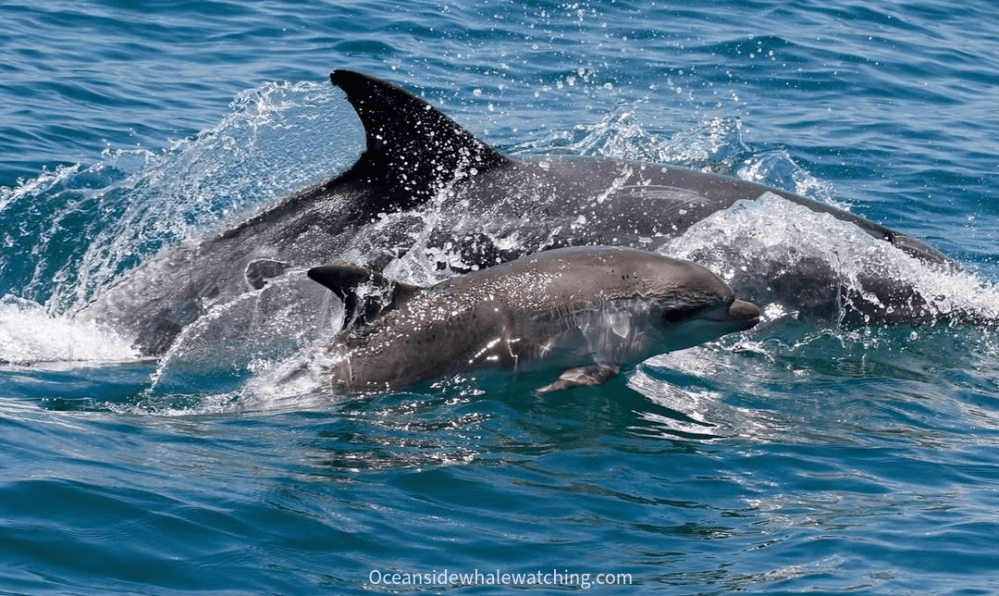
The four species above represent an unusual concentration of dolphin diversity for a single departure point. A few things make Oceanside particularly productive.
First, the bathymetry. The ocean floor drops off steeply just outside Oceanside Harbor, which means the boat reaches deep, nutrient-rich water within minutes. That transition zone between shallow coastal shelf and deep open ocean is exactly where dolphins concentrate to feed. Most other Southern California harbors require a longer run to reach comparable water.
Second, the uncrowded conditions. Oceanside Harbor has fewer commercial whale watching boats than places like Dana Point or San Diego. Less boat traffic means less disturbance to the animals and better viewing conditions for guests.
Third, the WILDCOAST partnership. Oceanside Adventures contributes $0.50 per ticket to WILDCOAST, a nonprofit focused on conserving coastal and marine ecosystems. The health of the local ecosystem directly affects the abundance and diversity of dolphins in our waters. Supporting conservation isn’t just good ethics. It’s good for future sightings.
When to See Dolphins in Oceanside
The short answer: any day, any season.
Unlike whales, dolphins don’t migrate. All four species found off Oceanside are present throughout the year. That said, the mix changes slightly by season. Common and bottlenose dolphins are consistent 365 days a year. Risso’s dolphins are present year-round but less predictable in timing. Pacific white-sided dolphins are more common in cooler months.
Calmer ocean conditions (typically mornings and late spring through early fall) tend to make dolphins easier to spot. But our captains know this water well and find dolphins in all kinds of conditions.
If you’re planning a trip, check the calendar and book online. Every two-hour tour is narrated by a certified naturalist who will help you identify the species you’re seeing and explain what’s happening in real time.