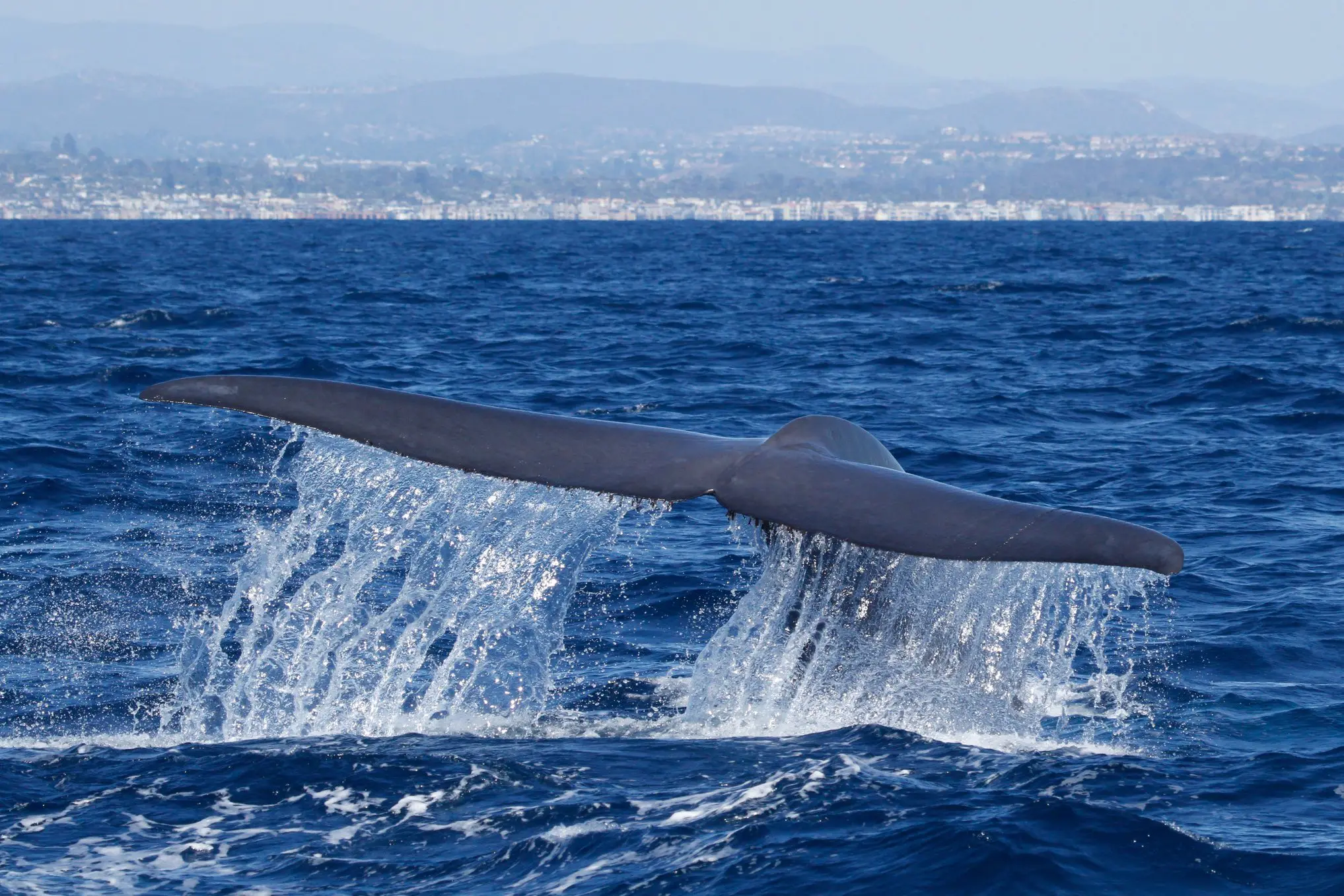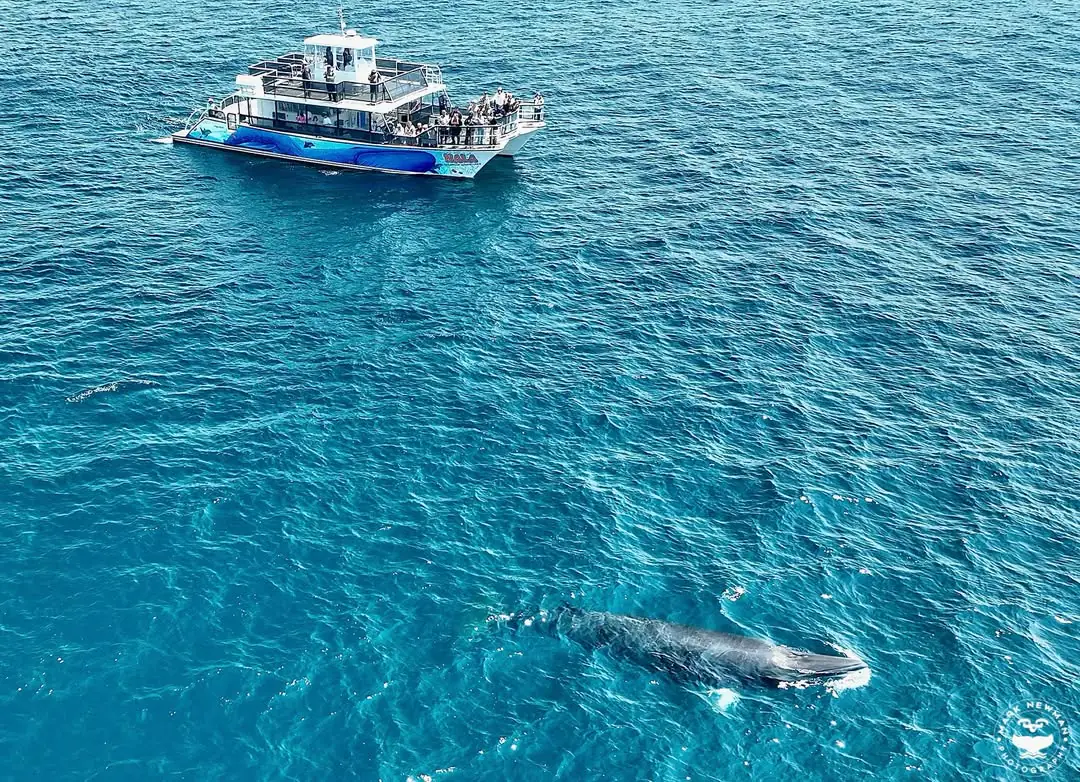

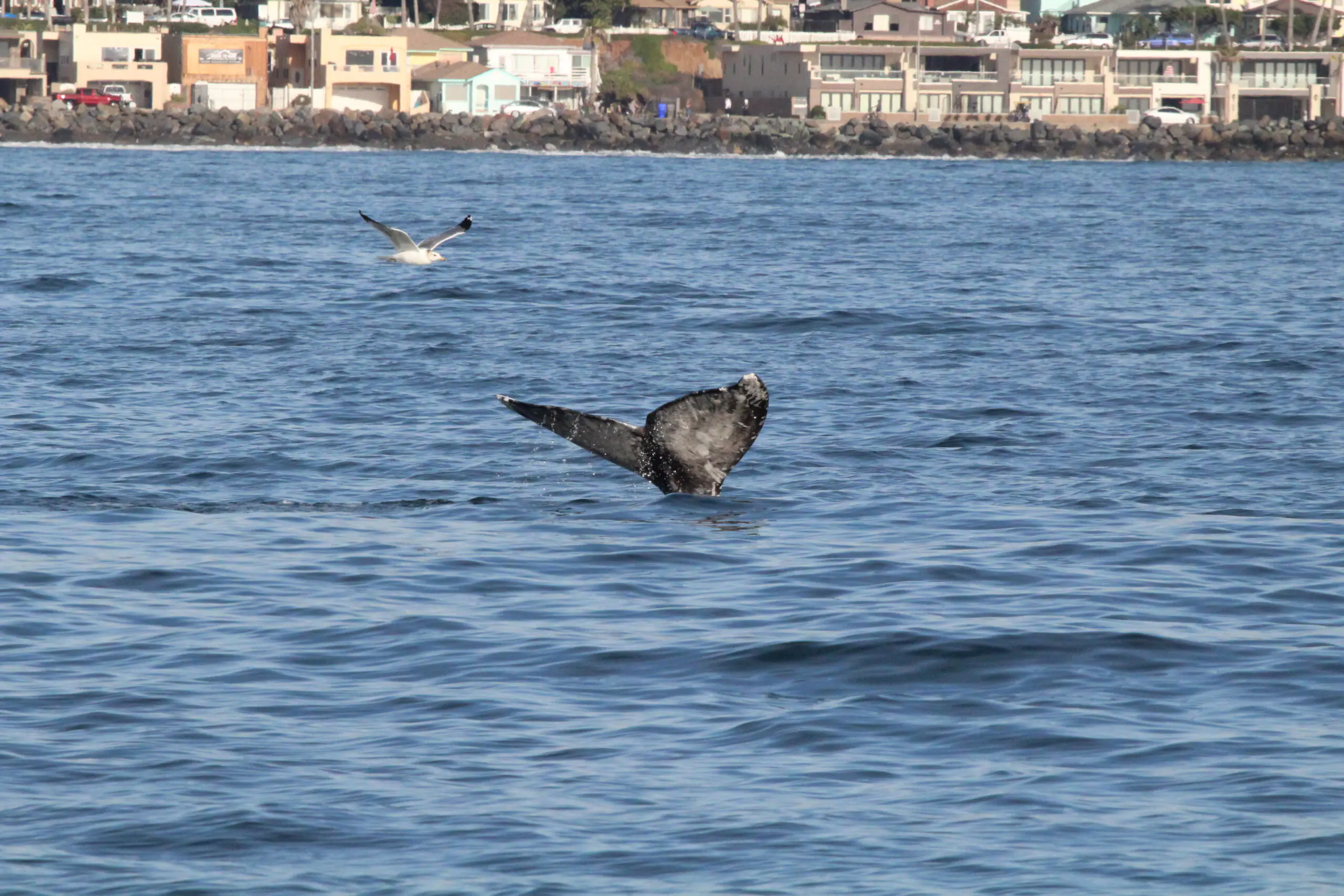
Every winter, gray whales swim down the Pacific coast from their summer feeding grounds in the Arctic to the lagoons of Baja California, Mexico, then turn around and head back north in spring. The route runs right past Oceanside Harbor. Gray whales mostly keep to shallow water near the coast, so they pass well within reach of a two-hour trip from the harbor.
Our crew has kept a sightings log on trips from Oceanside since July 2015. This guide to the 2026-27 season uses that log, last winter’s numbers and what NOAA Fisheries, the Oceanic Society and the Marine Mammal Center say about the migration. For the rest of the year, see whale watching season, month by month.
When Is Gray Whale Season in Oceanside?
Gray whales pass Oceanside from about December through April. The first southbound whale of the winter has turned up in our log as early as November 14 (in 2017) and as late as January 1 (in 2021). In 8 of the last 11 winters it arrived in December, and the last two came at the very end of the month: December 31, 2024 and December 30, 2025.
January and February are the busiest months. Since 2015 the crew has logged gray whales on about 70 percent of the January and February days in the log, and on just over half of the March days. April drops to about a quarter of days, and December is hit and miss at roughly one day in five.
The season has two halves. From December into February most of the whales are heading south to Baja California, where many give birth. NOAA Fisheries says the northbound migration along the U.S. West Coast runs from mid-February to May, and its calf counts show that moms with new calves leave last, passing between March and May.
Our month guides for December, January, February and March show how often the crew logs each species in that month, along with what to bring.
What Did the Crew Log Last Gray Whale Season?
The table shows gray whales on the crew’s sightings sheet from December 2025 through April 2026.
| Month | Days logged with gray whales | Gray whales counted |
|---|---|---|
| December 2025 | 2 of 22 | 6 |
| January 2026 | 14 of 26 | 39 |
| February 2026 | 11 of 18 | 25 |
| March 2026 | 6 of 28 | 8 |
| April 2026 | 3 of 24 | 7 |
That adds up to gray whales on 36 days between December 30 and April 19, and 85 gray whales counted. The counts add up across trips, so a whale seen on two trips counts twice. Two more were logged on May 20, the last of the season.
The best day was January 24, with 8 gray whales. The first sighting of the winter, on December 30, was a group of four that included two mom and calf pairs, and the crew logged more mom and calf pairs on January 12 and January 17. Those calves were probably born on the way south. NOAA says calves are born during the migration or in the lagoons of Mexico, and the Oceanic Society puts births between late December and early February.
Spring can bring more of them. In 2017 the crew logged mom and calf pairs heading north on nine days between April 1 and May 10.
Last winter’s log had plenty besides gray whales. Pacific white-sided dolphins, which visit for the winter, were logged on 17 days from December to February, and common dolphins on most days all season. In March fin whales took over, logged on 25 of the 28 days on the sheet.
What Has the Crew Logged So Far This Season?
When this guide went up on November 19, 2026, the crew had not logged a gray whale yet this season. November had belonged to humpback whales, logged on all 16 days on the sheet that month, with 22 of them on November 8. In most past winters the first gray whale showed up in December.
The latest days from the log are below and update every hour. The full record is on our whale sightings page.
- 9 humpback whales, 14 orcas, 1 hammerhead shark and 2 sunfish
- 8 humpback whales and 200 common dolphins
- 5 humpback whales, 300 common dolphins and 1 mako shark
- 20 humpback whales and 300 common dolphins
- 12 humpback whales and 200 common dolphins
How Do You Spot a Gray Whale?
Start with the blow. The Marine Mammal Center describes a gray whale’s spout as low and puffy or heart-shaped. The heart shape shows best when the whale is swimming straight toward you or away from you. Fin whales, which we also see in winter, send up a much taller and narrower spout.
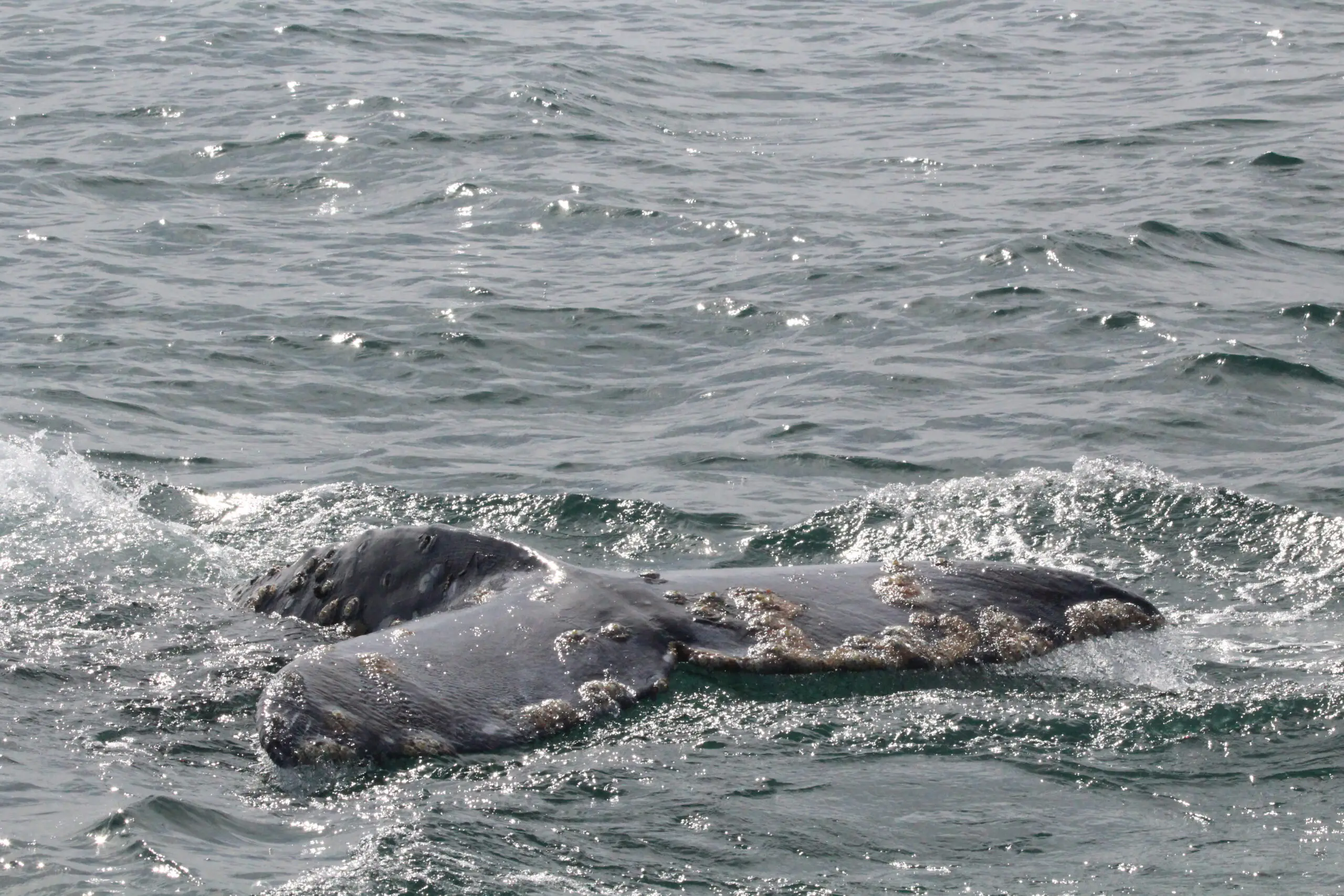
Next, look at the back. Gray whales have no dorsal fin. In its place is a low hump and, toward the tail, a row of 6 to 12 small bumps the Marine Mammal Center calls knuckles. The dark gray skin is covered in pale patches, which are mostly barnacles and whale lice. NOAA says they gather most on the head and tail, and the Marine Mammal Center says a single whale can carry more than 400 pounds of them.
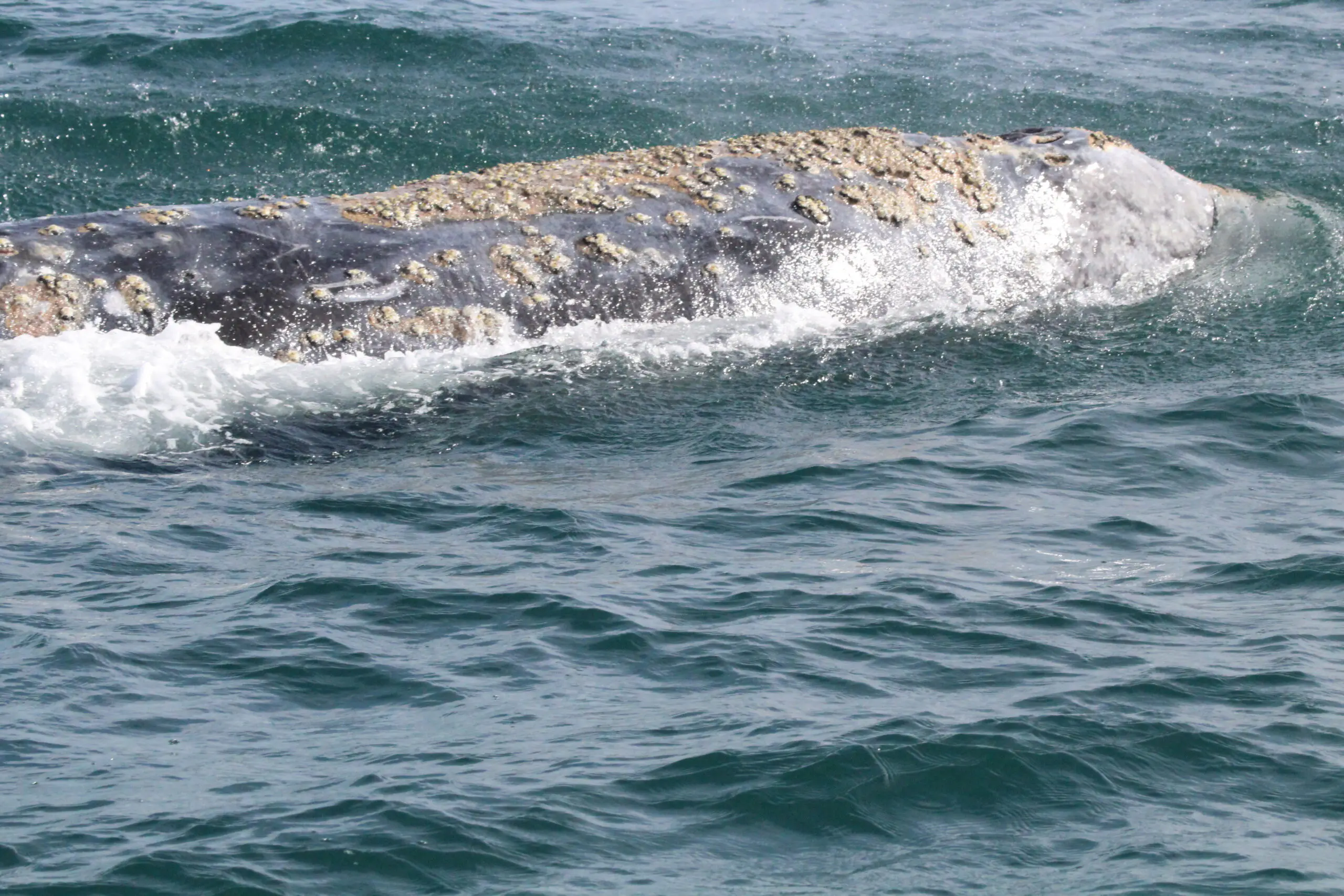
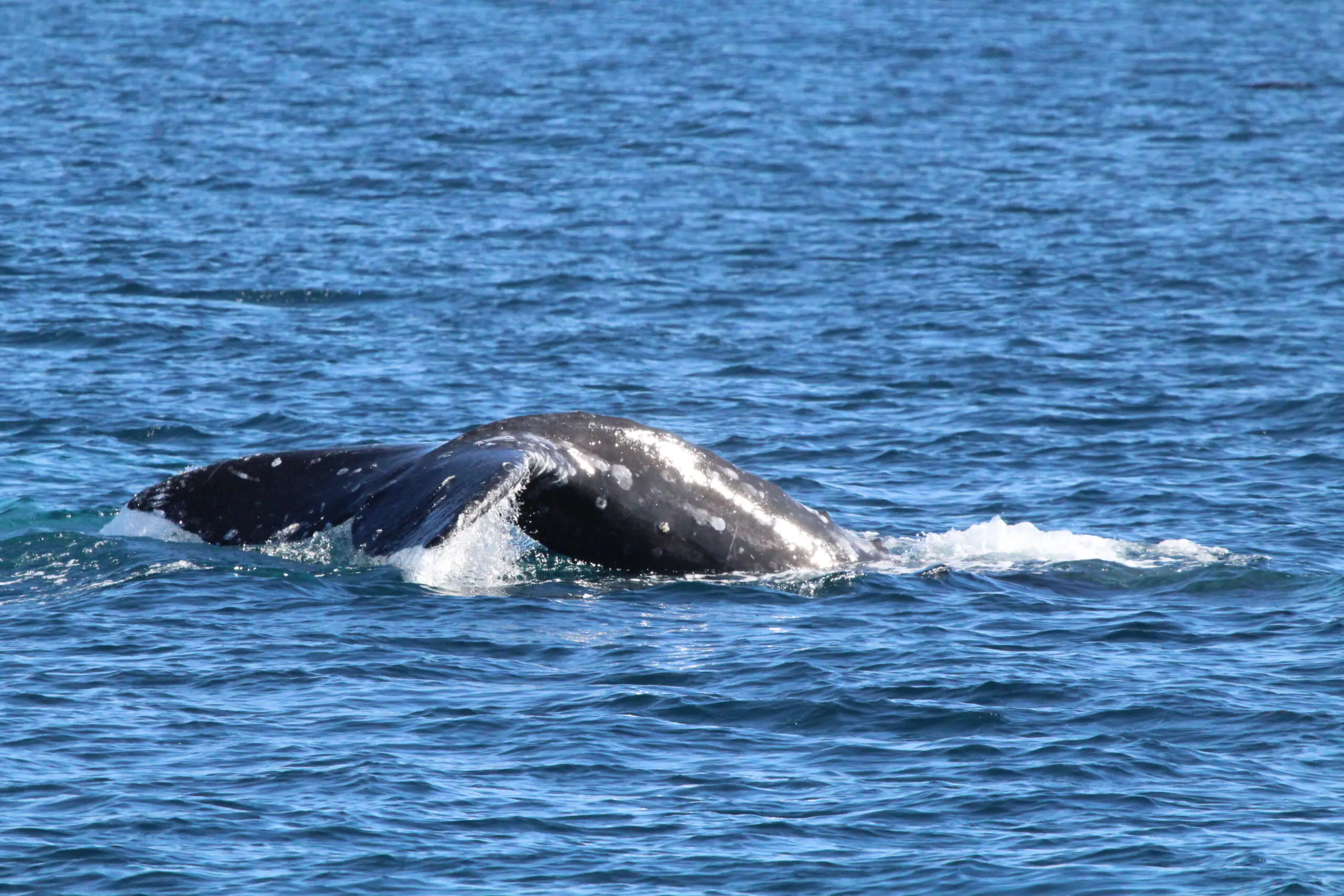
Then watch the spot where it went down. A gray whale often lifts its tail out of the water before a longer dive, and it usually comes back up further along the way it was heading. Now and then one pushes its head straight up out of the water and holds it there to look around, which is called spyhopping.
Why Does a Two-Hour Trip Suit Gray Whales?
NOAA describes gray whales as mainly a species of shallow coastal water, and the Oceanic Society notes that mom and calf pairs keep close to the coast for the whole migration. Off Oceanside the crew often finds them about a mile out. Our boats clear the harbor jetty and reach open water within minutes, so most of the two hours is spent looking for whales and watching them.
A traveling gray whale holds a steady course and comes up for a few breaths between dives. That gives the captain time to set up a good view while keeping the 100 yards that NOAA’s viewing guidelines ask for. Sometimes a whale chooses to swim closer to the boat on its own.
Trips are two hours and leave from Oceanside Harbor, usually aboard NALA, our main boat. NALA is 63 feet long with two decks and was built for us in 2024. We reserve the right to switch to our smaller catamaran, the 47-foot Oceanside Adventures, when scheduling requires it. Our captains are American Cetacean Society certified naturalists, and they narrate the trip and explain what each whale is doing. You can see both boats on our boats page.
When Should You Book a Gray Whale Trip?
In our log, January and February give you the best chance of a gray whale. If you would like to see a mom and calf heading north, March and April fall inside the March to May window NOAA gives for them, and those months bring fin whales too.
Departures are usually at 9:30 a.m., 12 p.m. and 2:30 p.m. Whales travel day and night, so no time of day is better than another for seeing them, but the water tends to be calmer in the morning, which helps if anyone in your group gets seasick. Trips often sell out, so book ahead. You can check each day’s times on the whale watching cruise page or book your gray whale trip online.
Check in at our kiosk by the Lighthouse, at 256 Harbor Drive South, at least 30 minutes before departure, or 45 minutes on weekends and holidays to leave time for parking. It’s always 10 to 15 degrees cooler on the ocean than in the harbor, and winter mornings on the water are cold, so bring a warm jacket, a hat and layers. Our guides on what to wear whale watching and how to avoid seasickness cover the rest, and our post on what the cruise costs covers prices.
A gift certificate for the cruise makes an easy holiday present for anyone who has always wanted to see the migration.
Gray Whale Questions
When do gray whales migrate past San Diego?
Off Oceanside, in North County San Diego, the crew logs gray whales from about December through April. The whales head south from December into February and north from mid-February into May. The Marine Mammal Center gives the same pattern for California as a whole, with whales passing in December and January on the way south and between March and May on the way north.
How far do gray whales migrate?
NOAA Fisheries calls it one of the longest annual migrations of any mammal, about 10,000 miles round trip between the Arctic and Baja California, and more than 14,000 miles for some whales.
How big is a gray whale?
Gray whales grow to about 49 feet long and weigh about 90,000 pounds, according to NOAA Fisheries. A newborn calf is 14 to 16 feet long and weighs about 2,000 pounds.
How many gray whales are there?
NOAA scientists count gray whales migrating past a watch station on the central California coast. Their latest estimate, published in July 2026, is about 17,750 eastern North Pacific gray whales, up from about 12,890 in the previous estimate. NOAA calls the increase apparent and is looking at whether survey factors explain part of it. This population was taken off the endangered species list in 1994.
Will we see a gray whale on our trip?
We can’t promise a sighting on any trip, because these are wild animals on the move. Since 2015 the crew has logged gray whales on about 70 percent of January and February days, and the sightings page shows what has turned up lately.
Book a Gray Whale Watching Trip
Our two-hour whale and dolphin cruise runs all winter from Oceanside Harbor, 30 minutes north of SeaWorld San Diego, with a naturalist captain narrating the whole way. Book online or call the office at 760-277-3737.